
Par Rikrit Tiravanija
Une structure en forme de moucharabieh devient le point de rencontre du Qatar à Venise, conçue pour les rassemblements, les performances et les rituels.
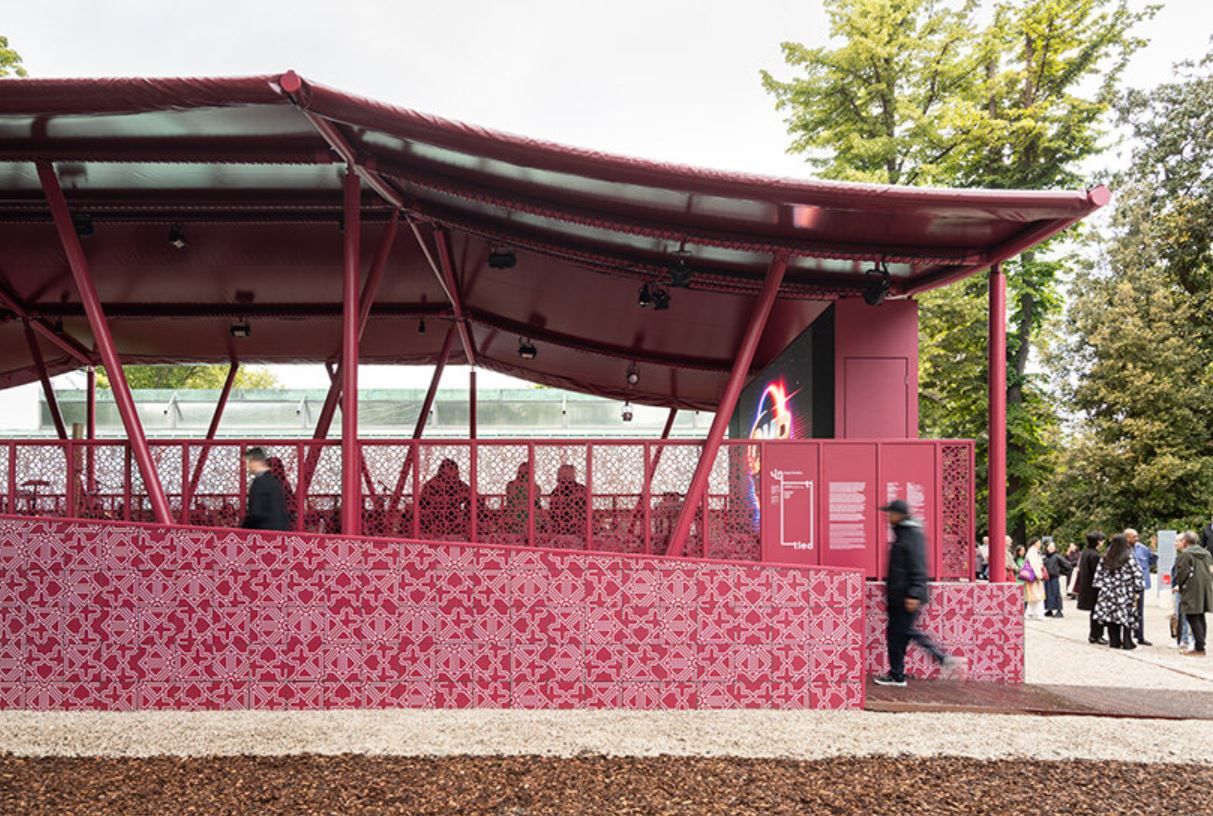
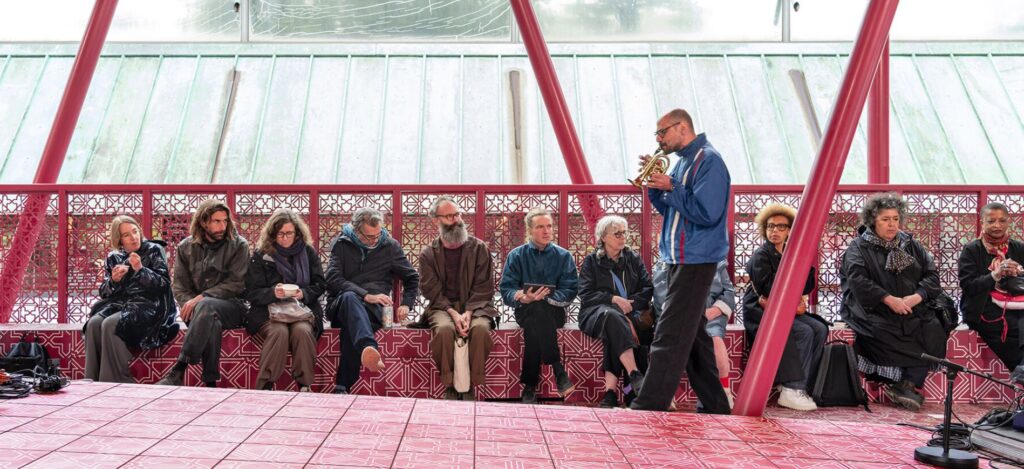
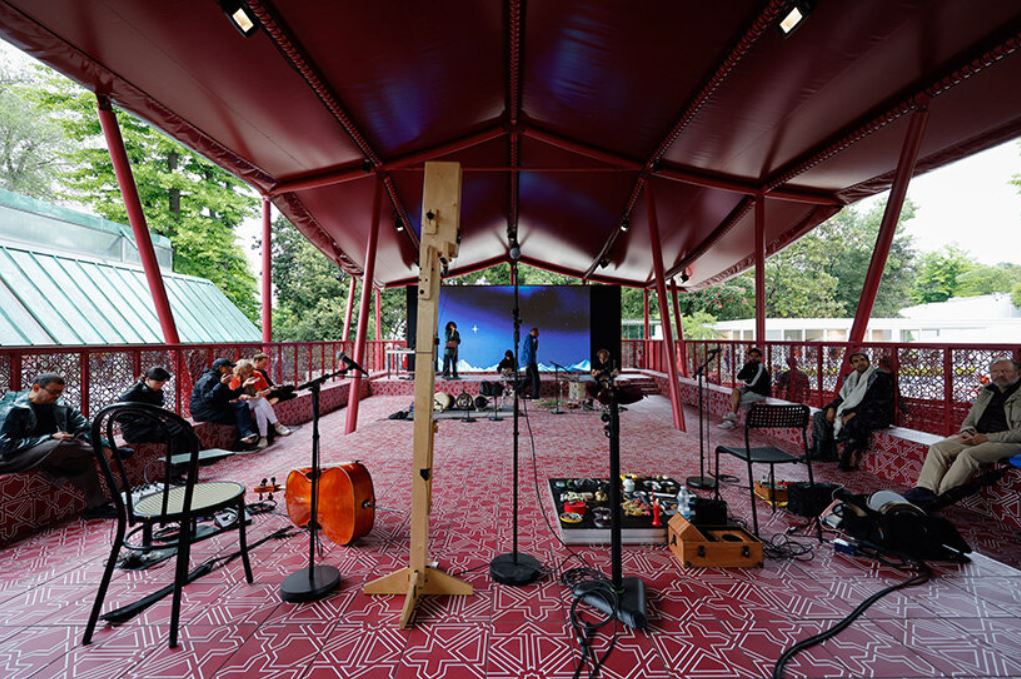
Sur le futur site du Pavillon permanent du Qatar dans les Giardini, la participation nationale du pays à la Biennale d’art de Venise 2026, intitulée « Sans titre 2026 (un rassemblement de personnes remarquables) », transforme l’espace du pavillon en un lieu de rencontre culturel évolutif, façonné par la performance, la gastronomie, le son et la participation collective. Ancrée par une structure bordeaux en forme de tente conçue par Rirkrit Tiravanija, l’exposition réunit des artistes, des musiciens, des poètes et des chefs du monde arabe et de la région MENASA.
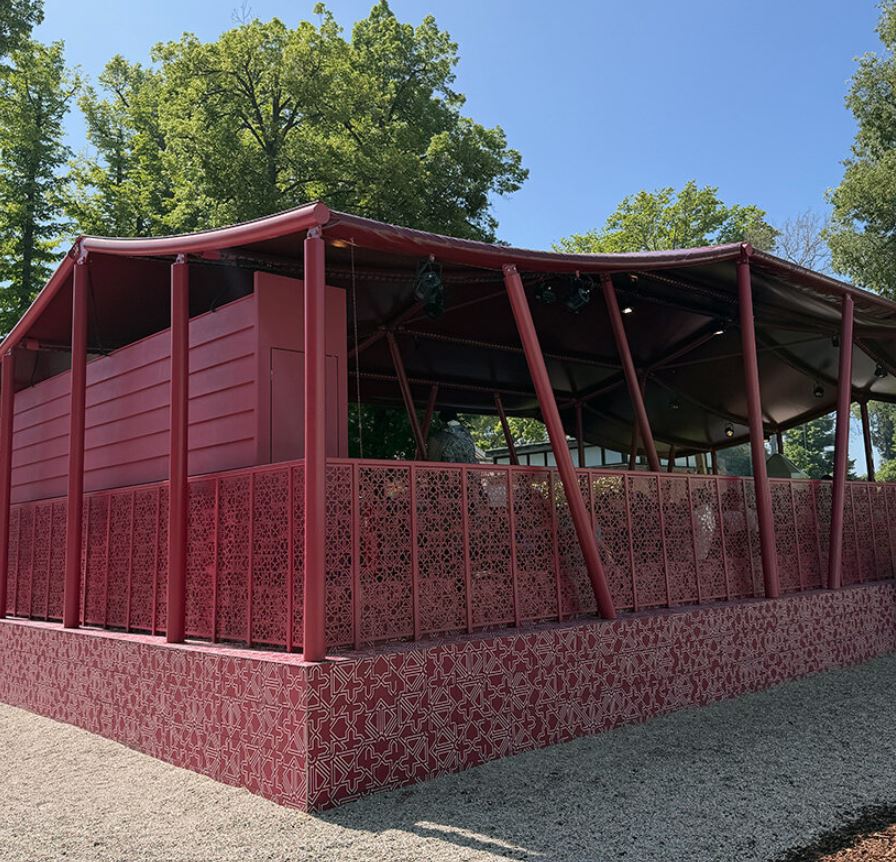
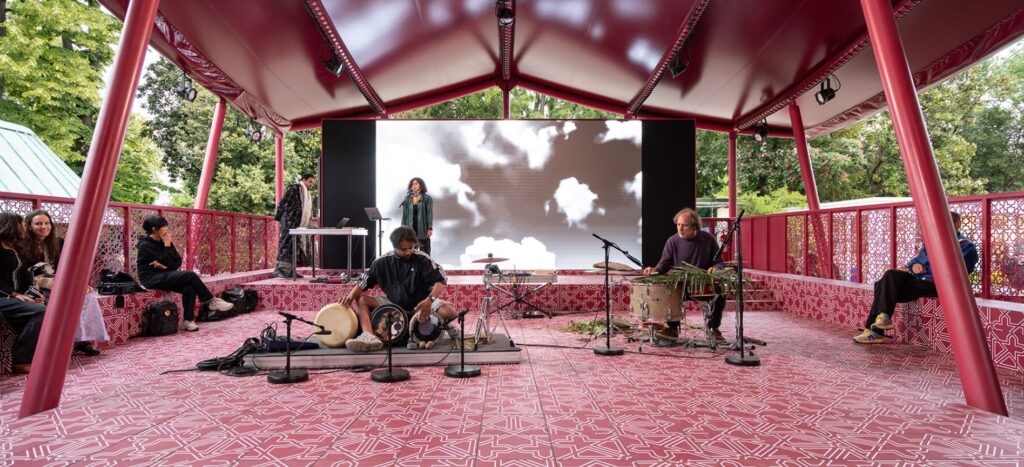
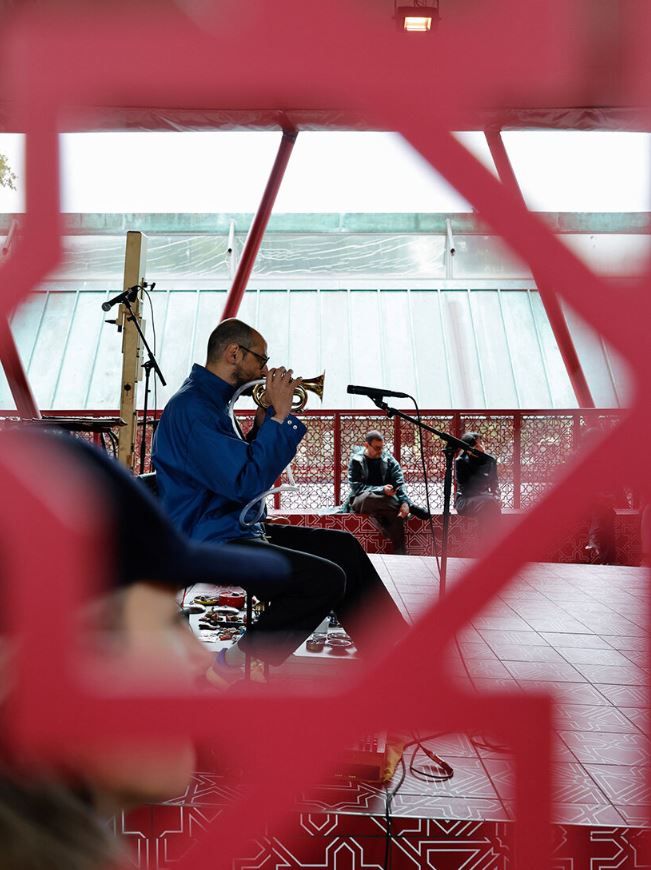
Commandé par Cheikha Al Mayassa bint Hamad bin Khalifa Al Thani et co-organisé par Tom Eccles et Ruba Katrib, le projet est conçu à la fois comme une architecture et une infrastructure sociale. L’intervention temporaire de Tiravanija fait référence aux espaces de rassemblement traditionnels qataris à travers un motif de moucharabieh fragmenté qui filtre la lumière, l’air et les mouvements sur le site, accueillant une série continue d’activités tout au long de la Biennale. Des performances en direct organisées par l’artiste sonore libanais Tarek Atoui se mêlent aux programmes culinaires élaborés par le chef palestinien Fadi Kattan.
Un pavillon éphémère façonné par la collaboration
L’exposition prolonge la pratique de longue date de Tiravanija, qui consiste à créer des environnements activés par l’interaction humaine et le partage d’expériences. La structure devient une plateforme de collaboration interdisciplinaire, invitant les visiteurs à découvrir des espaces animés par la gastronomie, des séances d’écoute, l’improvisation et des projections de films. Ce projet préfigure la construction du pavillon permanent Giardini du Qatar, conçu par Lina Ghotmeh et annoncé en début d’année.
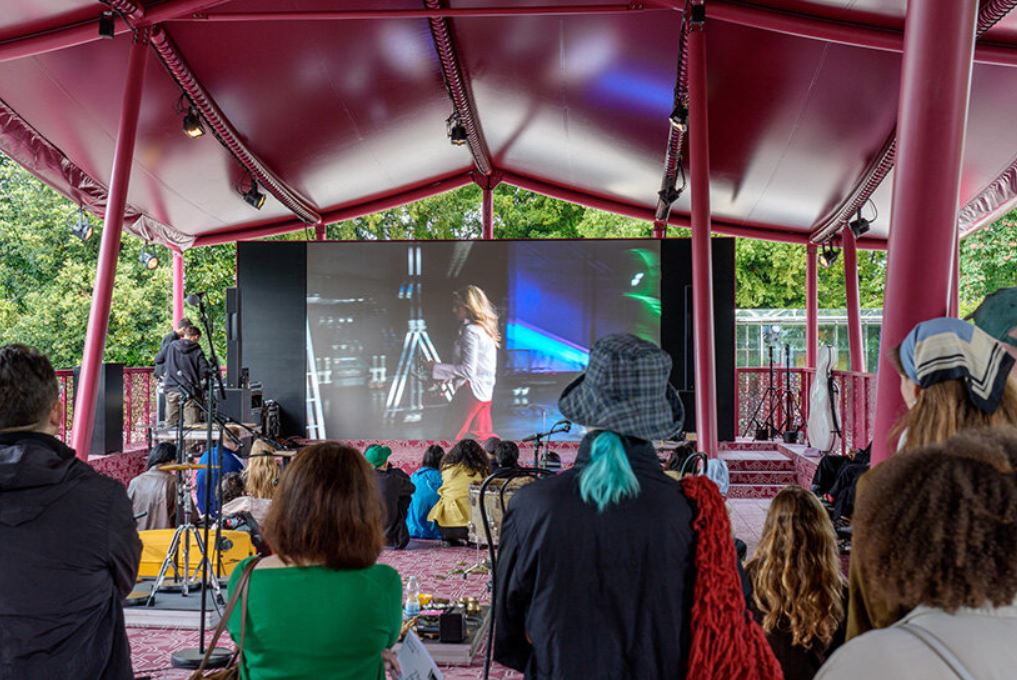
Parmi les œuvres présentées figure DAMAR TV (2026), un nouveau film narratif expérimental de l’artiste qatarie-américaine Sophia Al-Maria. Le film suit la journaliste de télévision Damar Darwish, interprétée par l’actrice libanaise Yumna Marwan, après qu’elle a perdu la voix lors d’une confrontation en direct. À travers des rencontres avec des musiciens tels que Fatima Al Qadiri, Dali de Saint Paul, Sarah Ourahmane et Sulafa Elyas, l’œuvre explore la frontière ténue entre spectacle médiatique, mémoire et transformation sonore.
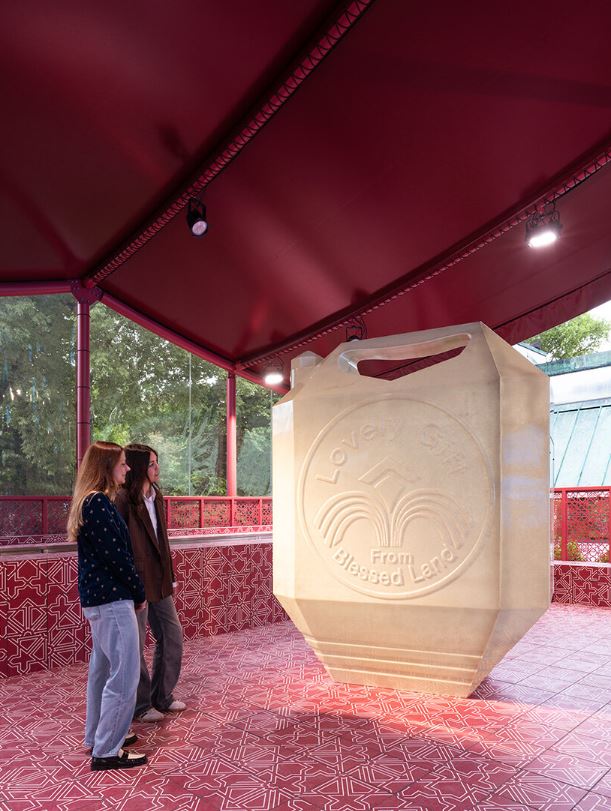
En parallèle de la projection du film, l’artiste koweïtienne-portoricaine Alia Farid présente Jerrican (2026), une sculpture monumentale en fibre de verre inspirée des récipients utilitaires à eau que l’on trouve couramment dans le Golfe. Agrandie à une échelle architecturale tout en étant creuse et légère, l’œuvre fait référence aux systèmes de circulation, de travail et d’infrastructures de ressources ancrés dans le paysage urbain du Golfe arabe.
Performances, enregistrements de terrain et rituels culinaires
Plus d’une douzaine d’activités se dérouleront entre les semaines d’ouverture et de clôture de la Biennale. Le programme d’Atoui s’inspire de ses recherches en cours sur les pratiques d’écoute et les archives sonores, intégrant des enregistrements réalisés le long du littoral qatari ainsi que des documents issus des archives sonores des années 1960 du preneur de son libanais Paul Matar. Des performances improvisées réinterprètent des enregistrements historiques à travers les traditions musicales électroniques et expérimentales contemporaines, tandis que les ateliers culinaires explorent les thèmes de la migration, de la préservation et des échanges à travers les ingrédients et les rituels de repas partagés.
Produite par Qatar Museums et présentée par Rubaiya Qatar, l’exposition précède la première édition de Rubaiya Qatar, la nouvelle quadriennale d’art contemporain du pays, qui sera lancée à Doha en novembre 2026.
Dans une déclaration accompagnant le projet, Cheikha Al Mayassa a décrit le pavillon comme une expression d’ouverture et d’humanité partagée à une époque marquée par les conflits et les divisions, soulignant la capacité de la culture à connecter les peuples à travers les visions, les sons et les saveurs du monde arabe.
La biennale cette année
Souvent décrite comme la première et la plus prestigieuse biennale au monde, la Biennale de Venise est depuis longtemps un espace où l’art et la politique se rencontrent. Scène où les nations présentent des œuvres qui reflètent, interpellent et répondent aux enjeux de leur époque, la regrettée Koyo Kouoh a proposé, pour sa 61e édition, le thème « En tonalités mineures », un cadre curatorial qui déplace l’attention du spectacle vers des fréquences plus subtiles : l’intimité, la mémoire, la résistance discrète et les récits souvent marginalisés. Dans un contexte international de plus en plus tendu, cette proposition résonne particulièrement fort.
L’art a toujours été une forme d’expression personnelle, mais aussi un moyen pour les pays d’affirmer leurs récits, leurs identités et leurs perspectives sur la scène mondiale. C’est ce qui rend la participation des pays arabes à la Biennale de cette année si significative. Leur présence témoigne d’une volonté collective d’être entendus dans un monde qui, trop souvent, préfère parler à notre place.
De la Méditerranée à l’océan Indien, les pavillons de cette année explorent le silence, le son, l’artisanat, la mémoire et les récits oraux. Ensemble, ils reflètent à la fois la continuité et le changement, marquant une expansion notable et attendue depuis longtemps.
Des sculptures représentant des bassins aux cuisines aux saveurs épicées, l’exposition du Qatar à la Biennale de Venise explore l’identité, l’hospitalité et les échanges culturels à travers le monde arabe et ses diasporas, au travers du son, du mouvement et des repas partagés. Dès l’entrée de l’exposition du Qatar à la Biennale de Venise, un immense bassin sculptural domine les visiteurs.
Un rassemblement de personnalités remarquables
L’œuvre, intitulée « Jerrican », est une création de l’artiste koweïtienne-portoricaine Alia Farid. Elle s’inspire des récipients traditionnels du Golfe utilisés pour offrir de l’eau aux voyageurs traversant le désert. « Je réfléchis à la manière dont la modernité redéfinit la communauté et les rituels », explique-t-elle. L’œuvre est liée à une tradition du Golfe consistant à offrir de l’eau aux voyageurs dans le désert. Cette exposition temporaire investit le futur emplacement du pavillon permanent du Qatar dans les Giardini et réunit des artistes, des musiciens et des chefs venus de tout le monde arabe et de sa diaspora.
À l’intérieur, les visiteurs peuvent assister à des performances, des projections de films et découvrir des cuisines proposant des plats inspirés des saveurs du Moyen-Orient.
« Du XIIIe au XVe siècle, toutes les épices destinées à l’Europe transitaient par le monde arabe pour arriver à Venise », explique Kattan. « C’est comme si, mille ans plus tard, nous étions toujours là. » Même les boissons servies dans le pavillon reflètent ces multiples échanges culturels.
Un espace conçu pour se rassembler
Les visiteurs sont invités à s’asseoir, à manger, à écouter de la musique et à passer du temps dans cet espace plutôt que de simplement le traverser. « Les gens discutent, boivent des jus de fruits, mangent, écoutent de la musique, regardent le film et se détendent », explique Ruba Katrib, co-commissaire de l’exposition. « C’est donc avant tout un lieu de rencontre, un espace d’échange. »
Cette atmosphère évolutive correspond exactement à ce que les organisateurs souhaitaient créer. Loin d’être une exposition statique, le pavillon se transforme constamment au gré des sons, des mouvements et des interactions, façonné autant par les visiteurs que par les œuvres elles-mêmes.
Texte traduit par ArchiMag
Qatar pavilion, Venice biennale
By Rikrit Tiravanija
Mashrabiya structure becomes Qatar’s meeting point in Venice, designed for gatherings, performances and rituals
At the future site of the permanent Qatar Pavilion in the Giardini, the country’s national participation at Venice Art Biennale 2026, named ‘untitled 2026 (a gathering of remarkable people)’, transforms the pavilion grounds into an evolving cultural meeting place shaped by performance, cuisine, sound, and collective participation. Anchored by a maroon tent-like structure designed by Rirkrit Tiravanija, the exhibition brings together artists, musicians, poets, and chefs from across the Arab world and the broader MENASA region.
Commissioned by Sheikha Al Mayassa bint Hamad bin Khalifa Al Thani and co-curated by Tom Eccles and Ruba Katrib, the project is conceived as both architecture and social infrastructure. Tiravanija’s temporary intervention references traditional Qatari gathering spaces through a fragmented mashrabiya pattern that filters light, air, and movement across the site, housing a continuous series of activations running throughout the duration of the Biennale. Live performances organized by Lebanese sound artist Tarek Atoui intersect with culinary programs developed by Palestinian chef Fadi Kattan.
A temporary pavilion shaped by collaboration
The exhibition expands on Tiravanija’s long-running practice of creating environments activated through human interaction and shared experience. The structure becomes a platform for interdisciplinary collaboration, inviting visitors into spaces animated by food, listening sessions, improvisation, and film screenings. The project anticipates the construction of Qatar’s permanent Giardini pavilion designed by Lina Ghotmeh, announced earlier this year.
Among the featured works is DAMAR TV (2026), a new experimental narrative film by Qatari-American artist Sophia Al-Maria. The film follows television journalist Damar Darwish, portrayed by Lebanese actress Yumna Marwan, after she loses her voice during a live broadcast confrontation. Through encounters with musicians including Fatima Al Qadiri, Dali de Saint Paul, Sarah Ourahmane, and Sulafa Elyas, the work explores the unstable boundary between media spectacle, memory, and sonic transformation.
Alongside the film, Kuwaiti-Puerto Rican artist Alia Farid presents Jerrican (2026), a monumental fiberglass sculpture based on the utilitarian water containers commonly found across the Gulf. Enlarged to architectural scale yet hollow and lightweight, the work references systems of circulation, labor, and resource infrastructure embedded within the urban landscape of the Arabian Gulf.
Performances, field recordings and culinary rituals
More than a dozen activations will take place between the Biennale’s opening and closing weeks. Atoui’s program draws from his ongoing research into listening practices and archival sound, incorporating recordings captured along Qatar’s coastline together with material from Lebanese sound recorder Paul Matar’s 1960s archive. Improvisational performances reinterpret historical recordings through contemporary electronic and experimental music traditions, while culinary programs explore migration, preservation, and exchange through ingredients and communal dining rituals.
Produced by Qatar Museums and presented by Rubaiya Qatar, the exhibition arrives ahead of the inaugural edition of Rubaiya Qatar, the new contemporary art quadrennial of the country set to launch in Doha in November 2026.
In a statement accompanying the project, Sheikha Al Mayassa described the pavilion as an expression of openness and shared humanity during a moment marked by conflict and division, emphasizing culture’s capacity to connect people through visions, sounds, and flavors across the Arab world.
Often described as the world’s first and most historic biennale, the Venice Biennale has long existed as a space where art and politics intersect. A stage where nations present works that reflect, challenge, and respond to the urgencies of their time, for its 61st edition, the late Koyo Kouoh proposed the theme In Minor Keys; a curatorial framework that shifts attention away from spectacle and toward quieter frequencies: intimacy, memory, subtle resistance, and the stories often pushed to the margins. In moments like these, when the global climate feels increasingly charged, that proposition feels especially resonant.
Art has always been a form of self-expression, but it is also a way for countries to assert narratives, identities, and perspectives on a global stage. This is what makes the participation of Arab countries in this year’s Biennale particularly significant. Their presence serves as a collective insistence on being heard in a world that too often prefers to speak for us.
From the Mediterranean to the Indian Ocean, this year’s pavilions move through silence, sound, craft, memory, and oral histories. Together, they reflect both continuity and change, marking a notable expansion in representation that feels long overdue.
From sculptural water vessels to spice-filled kitchens, Qatar’s Venice Biennale exhibition explores identity, hospitality and cultural exchange across the Arab world and its diasporas through sound, movement and shared meals. Just inside the entrance to Qatar’s Venice Biennale exhibition stands a giant sculptural water vessel towering above visitors as they walk in.
A gathering of remarkable people
The work, called “Jerrican,” was created by Kuwaiti-Puerto Rican artist Alia Farid and draws inspiration from traditional Gulf containers used to offer water to travelers crossing the desert. Thinking about how modernity sort of reconfigures community and ritual,” .The work is related to a tradition in the Gulf around offering water to travelers in the desert. The temporary exhibition activates the future site of Qatar’s permanent pavilion in the Giardini and brings together artists, musicians and chefs from across the Arab world and its diasporas.
Inside, visitors move between performances, film screenings and kitchens serving dishes inspired by flavours from across the Middle East.
« From the 13th to the 15th century, all spices that came to Europe came through the Arab world into Venice,” Kattan said. “So it’s like a thousand years later, “Hello, we’re still here.” Even the drinks served inside the pavilion reflect those layers of cultural exchange.
A space designed for gathering
Visitors are encouraged to sit, eat, listen to music and spend time inside the space rather than simply walk through it. “People are talking, they’re drinking juices, they’re eating food, they’re listening to music, they are watching the film, and they’re hanging out here,” said co-curator Ruba Katrib. “So it’s really about a gathering space, a space of coming together.”
That evolving atmosphere is exactly what organizers hoped to create. Rather than a static exhibition, the pavilion shifts constantly through sound, movement and interaction, shaped as much by the visitors inside it as the artworks themselves.
Project info:
Name: a gathering of remarkable people
Event: 61st International Art Exhibition – La Biennale di Venezia
Designer: Rirkrit Tiravanija
Location: Giardini della Biennale, Venice
Commissioner: Sheikha Al Mayassa bint Hamad bin Khalifa Al Thani
Curators: Tom Eccles and Ruba Katrib
Artists: Rirkrit Tiravanija, Sophia Al-Maria, Tarek Atoui, Alia Farid
Culinary program: Fadi Kattan
Produced by: Qatar Museums | @qatar_museums
Presented by: Rubaiya Qatar
Images by Andrea Avezzù, Giuseppe Miotto, Marco Cappelletti Studio
Sources : euronews, designboom
