

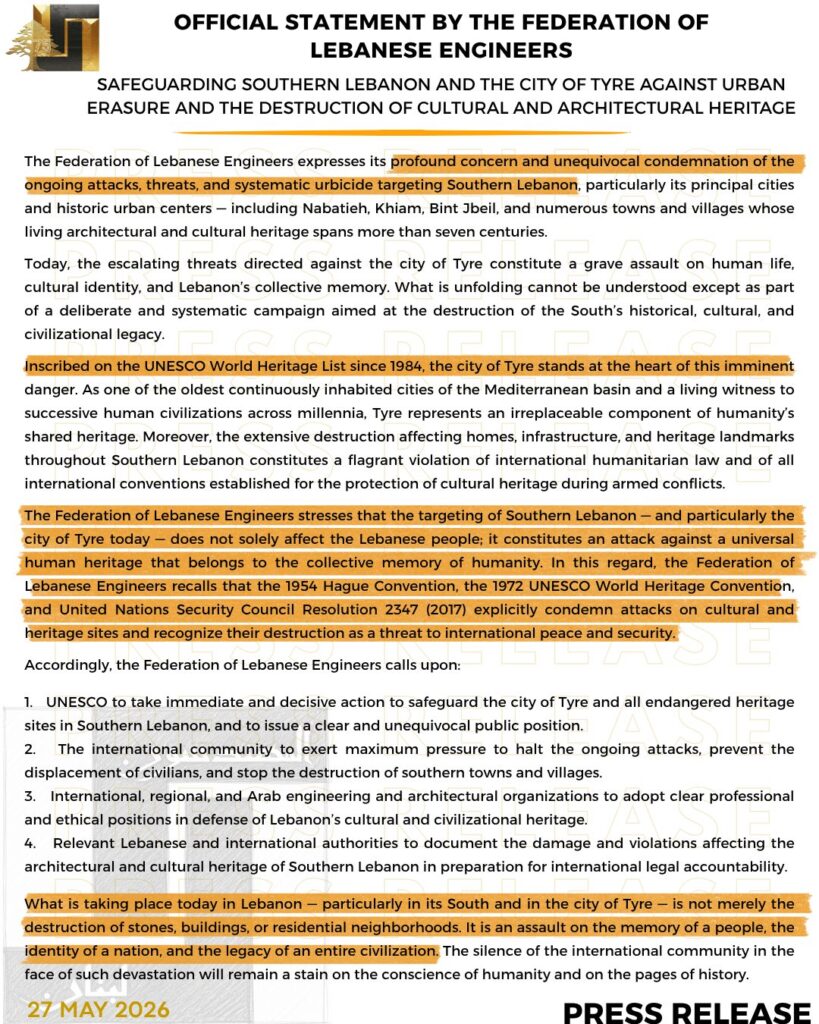
Official Statement by The Federation of Lebanese Engineers
Safeguarding Southern Lebanon and the City of Tyre Against Urban Erasure and the Destruction of Cultural and Architectural Heritage
The Federation of Lebanese Engineers expresses its profound concern and unequivocal condemnation of the ongoing attacks, threats, and systematic urbicide targeting Southern Lebanon, particularly its principal cities and historic urban centers — including Nabatieh, Khiam, Bint Jbeil, and numerous towns and villages whose living architectural and cultural heritage spans more than seven centuries.
Today, the escalating threats directed against the city of Tyre constitute a grave assault on human life, cultural identity, and Lebanon’s collective memory. What is unfolding cannot be understood except as part of a deliberate and systematic campaign aimed at the destruction of the South’s historical, cultural, and civilizational legacy.
Inscribed on the UNESCO World Heritage List since 1984, the city of Tyre stands at the heart of this imminent danger. As one of the oldest continuously inhabited cities of the Mediterranean basin and a living witness to successive human civilizations across millennia, Tyre represents an irreplaceable component of humanity’s shared heritage. Moreover, the extensive destruction affecting homes, infrastructure, and heritage landmarks throughout Southern Lebanon constitutes a flagrant violation of international humanitarian law and of all international conventions established for the protection of cultural heritage during armed conflicts.
The Federation of Lebanese Engineers stresses that the targeting of Southern Lebanon — and particularly the city of Tyre today — does not solely affect the Lebanese people; it constitutes an attack against a universal human heritage that belongs to the collective memory of humanity. In this regard, the Federation of Lebanese Engineers recalls that the 1954 Hague Convention, the 1972 UNESCO World Heritage Convention, and United Nations Security Council Resolution 2347 (2017) explicitly condemn attacks on cultural and heritage sites and recognize their destruction as a threat to international peace and security.
Accordingly, the Federation of Lebanese Engineers calls upon:
- UNESCO to take immediate and decisive action to safeguard the city of Tyre and all endangered heritage sites in Southern Lebanon, and to issue a clear and unequivocal public position.
- The international community to exert maximum pressure to halt the ongoing attacks, prevent the displacement of civilians, and stop the destruction of southern towns and villages.
- International, regional, and Arab engineering and architectural organizations to adopt clear professional and ethical positions in defense of Lebanon’s cultural and civilizational heritage.
- Relevant Lebanese and international authorities to document the damage and violations affecting the architectural and cultural heritage of Southern Lebanon in preparation for international legal accountability.
What is taking place today in Lebanon — particularly in its South and in the city of Tyre — is not merely the destruction of stones, buildings, or residential neighborhoods. It is an assault on the memory of a people, the identity of a nation, and the legacy of an entire civilization. The silence of the international community in the face of such devastation will remain a stain on the conscience of humanity and on the pages of history.
The Federation of Lebanese Engineers
Beirut – Lebanon
27 May 2026
PS from Middle East Eye : For a month now, the Lebanese city has been a shadow of itself.
Continuously inhabited for 4,000 years, Tyre is written in gold letters in the history of the Mediterranean basin. Its sailors, the Phoenicians, contributed to the construction of large cities across the sea, such as Carthage in Tunisia and Cadiz in Spain.
Tyre has many ancient sites, mostly located in an area known as Al Mina (the harbour), and the city as a whole was added to the list of Unesco World Heritage Sites in 1984.
« Archaeological sites are usually far from cities and not very accessible to the population. In Tyre, however, they are part of the landscape, of the collective identity, » Alia Fares, an archaeologist and heritage consultant for the American Society of Overseas Research (ASOR), told MEE. « That is why the residents are so concerned. »
