<br />
<b>Notice</b>:  La fonction _load_textdomain_just_in_time a été appelée de façon <strong>incorrecte</strong>. Le chargement de la traduction pour le domaine <code>soledad</code> a été déclenché trop tôt. Cela indique généralement que du code dans l’extension ou le thème s’exécute trop tôt. Les traductions doivent être chargées au moment de l’action <code>init</code> ou plus tard. Veuillez lire <a href="https://developer.wordpress.org/advanced-administration/debug/debug-wordpress/">Débogage dans WordPress</a> (en) pour plus d’informations. (Ce message a été ajouté à la version 6.7.0.) in <b>/home/archimag/www/wp-includes/functions.php</b> on line <b>6260</b><br />
<?xml version="1.0" encoding="UTF-8"?><rss version="2.0"
	xmlns:content="http://purl.org/rss/1.0/modules/content/"
	xmlns:wfw="http://wellformedweb.org/CommentAPI/"
	xmlns:dc="http://purl.org/dc/elements/1.1/"
	xmlns:atom="http://www.w3.org/2005/Atom"
	xmlns:sy="http://purl.org/rss/1.0/modules/syndication/"
	xmlns:slash="http://purl.org/rss/1.0/modules/slash/"
	>

<channel>
	<title>Archives des éroport international de Bole (BIA) - ArchiMag</title>
	<atom:link href="http://archimag.tn/tag/eroport-international-de-bole-bia/feed/" rel="self" type="application/rss+xml" />
	<link>https://archimag.tn/tag/eroport-international-de-bole-bia/</link>
	<description>Architecture Magazine</description>
	<lastBuildDate>Thu, 15 Jan 2026 19:44:01 +0000</lastBuildDate>
	<language>fr-FR</language>
	<sy:updatePeriod>
	hourly	</sy:updatePeriod>
	<sy:updateFrequency>
	1	</sy:updateFrequency>
	<generator>https://wordpress.org/?v=7.1</generator>
	<item>
		<title>Le plus grand aéroport d&#8217;Afrique en construction en Ethiopie</title>
		<link>http://archimag.tn/2026/01/17/le-plus-grand-aeroport-dafrique-en-construction-en-ethiopie/</link>
					<comments>http://archimag.tn/2026/01/17/le-plus-grand-aeroport-dafrique-en-construction-en-ethiopie/#respond</comments>
		
		<dc:creator><![CDATA[Archi Mag]]></dc:creator>
		<pubDate>Sat, 17 Jan 2026 06:00:00 +0000</pubDate>
				<category><![CDATA[Projets]]></category>
		<category><![CDATA[Actualités]]></category>
		<category><![CDATA[Addis-Abeba]]></category>
		<category><![CDATA[Afrique]]></category>
		<category><![CDATA[ArchiMag]]></category>
		<category><![CDATA[Architecture]]></category>
		<category><![CDATA[Bishoftu (BIA)]]></category>
		<category><![CDATA[certification LEED Gold]]></category>
		<category><![CDATA[concepteur aéroportuaire]]></category>
		<category><![CDATA[Dar Al-Handasah]]></category>
		<category><![CDATA[éroport international de Bole (BIA)]]></category>
		<category><![CDATA[Ethiopian Airlines]]></category>
		<category><![CDATA[Ethiopie]]></category>
		<category><![CDATA[hub]]></category>
		<category><![CDATA[IATA]]></category>
		<category><![CDATA[magazine]]></category>
		<category><![CDATA[Magazine d&#039;architecture en ligne]]></category>
		<category><![CDATA[Maghreb]]></category>
		<category><![CDATA[revue]]></category>
		<category><![CDATA[Zaha Hadid Architects (ZHA)]]></category>
		<guid isPermaLink="false">https://archimag.tn/?p=4492</guid>

					<description><![CDATA[<p>Ethiopian Airlines Group a lancé la construction de ce qui deviendra le plus grand&#8230;</p>
<p>L’article <a href="http://archimag.tn/2026/01/17/le-plus-grand-aeroport-dafrique-en-construction-en-ethiopie/">Le plus grand aéroport d&rsquo;Afrique en construction en Ethiopie</a> est apparu en premier sur <a href="http://archimag.tn">ArchiMag</a>.</p>
]]></description>
										<content:encoded><![CDATA[
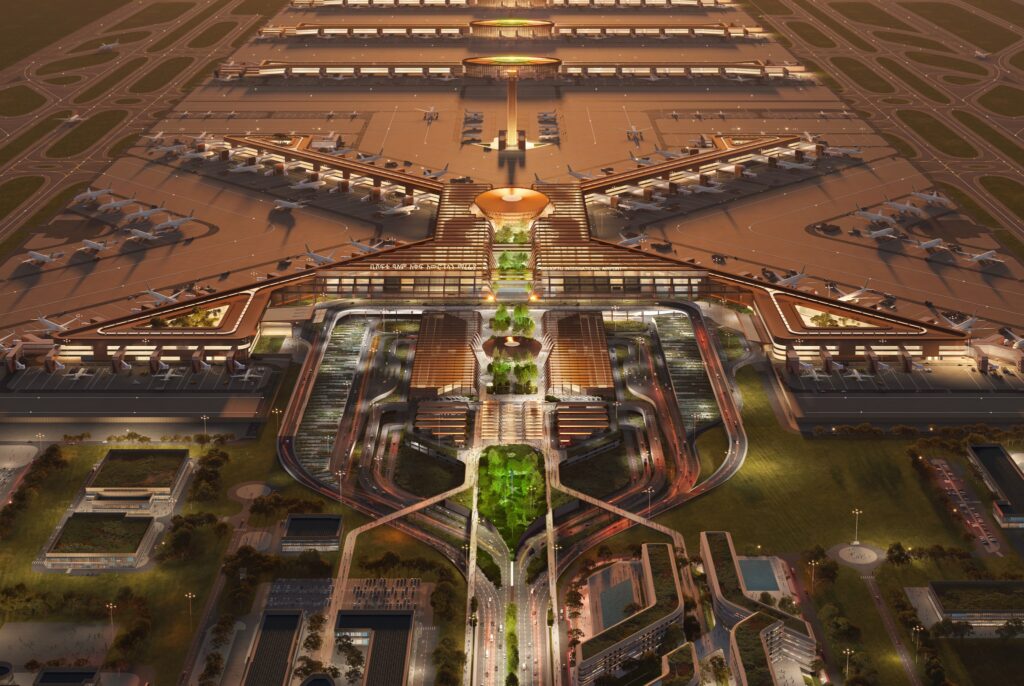
<p class="wp-block-paragraph">Ethiopian Airlines Group a lancé la construction de ce qui deviendra le plus grand aéroport d&rsquo;Afrique, l&rsquo;aéroport international de Bishoftu (BIA), conçu par le <strong><em>cabinet Zaha Hadid Architects (ZHA)</em></strong> et situé à environ 40 kilomètres au sud-est d&rsquo;Addis-Abeba. Avec une capacité annuelle initiale de 60 millions de passagers, qui atteindra 110 millions une fois pleinement opérationnel, ce projet représente un tournant majeur pour les infrastructures du pays et positionne l&rsquo;Éthiopie comme une plaque tournante du transport aérien entre l&rsquo;Afrique, l&rsquo;Asie et le Moyen-Orient.</p>


<div class="wp-block-image">
<figure class="aligncenter size-large"><img fetchpriority="high" decoding="async" width="1024" height="686" src="https://archimag.tn/wp-content/uploads/2026/01/aeroport-addis-abeba-2-1024x686.jpg" alt="" class="wp-image-4494" srcset="http://archimag.tn/wp-content/uploads/2026/01/aeroport-addis-abeba-2-1024x686.jpg 1024w, http://archimag.tn/wp-content/uploads/2026/01/aeroport-addis-abeba-2-300x201.jpg 300w, http://archimag.tn/wp-content/uploads/2026/01/aeroport-addis-abeba-2-768x514.jpg 768w, http://archimag.tn/wp-content/uploads/2026/01/aeroport-addis-abeba-2-1536x1028.jpg 1536w, http://archimag.tn/wp-content/uploads/2026/01/aeroport-addis-abeba-2-1170x783.jpg 1170w, http://archimag.tn/wp-content/uploads/2026/01/aeroport-addis-abeba-2-1920x1285.jpg 1920w, http://archimag.tn/wp-content/uploads/2026/01/aeroport-addis-abeba-2-585x392.jpg 585w, http://archimag.tn/wp-content/uploads/2026/01/aeroport-addis-abeba-2-263x175.jpg 263w, http://archimag.tn/wp-content/uploads/2026/01/aeroport-addis-abeba-2.jpg 2048w" sizes="(max-width: 1024px) 100vw, 1024px" /></figure>
</div>


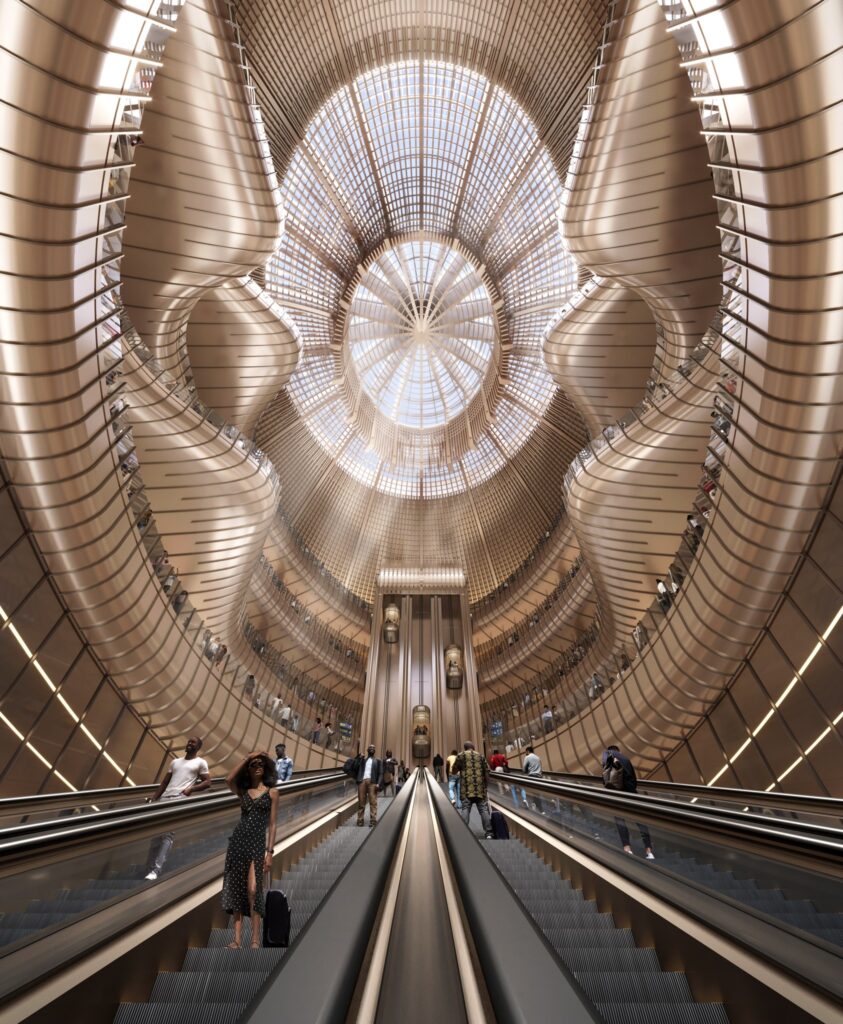
<p class="wp-block-paragraph">Le concept architectural s&rsquo;inspire de la géographie et de la diversité culturelle de l&rsquo;Éthiopie. Un axe central structure le terminal et ses jetées, réduisant les temps de correspondance tout en servant de point d&rsquo;ancrage spatial. Chaque jetée présente des palettes de matériaux et de couleurs intérieures distinctes, évoquant les différentes régions du pays. L&rsquo;agencement général s&rsquo;inspire de la vallée du Grand Rift, qui longe Bishoftu, et utilise une géométrie linéaire continue pour organiser l&rsquo;espace complexe et simplifier l&rsquo;orientation.</p>


<div class="wp-block-image">
<figure class="aligncenter size-large"><img decoding="async" width="843" height="1024" src="https://archimag.tn/wp-content/uploads/2026/01/aeroport-addis-abeba-3-843x1024.jpg" alt="" class="wp-image-4495" srcset="http://archimag.tn/wp-content/uploads/2026/01/aeroport-addis-abeba-3-843x1024.jpg 843w, http://archimag.tn/wp-content/uploads/2026/01/aeroport-addis-abeba-3-247x300.jpg 247w, http://archimag.tn/wp-content/uploads/2026/01/aeroport-addis-abeba-3-768x933.jpg 768w, http://archimag.tn/wp-content/uploads/2026/01/aeroport-addis-abeba-3-1265x1536.jpg 1265w, http://archimag.tn/wp-content/uploads/2026/01/aeroport-addis-abeba-3-1170x1421.jpg 1170w, http://archimag.tn/wp-content/uploads/2026/01/aeroport-addis-abeba-3-585x711.jpg 585w, http://archimag.tn/wp-content/uploads/2026/01/aeroport-addis-abeba-3.jpg 1686w" sizes="(max-width: 843px) 100vw, 843px" /></figure>
</div>


<p class="wp-block-paragraph"><strong>Conçu en fonction des passagers en correspondance et des longues escales</strong></p>


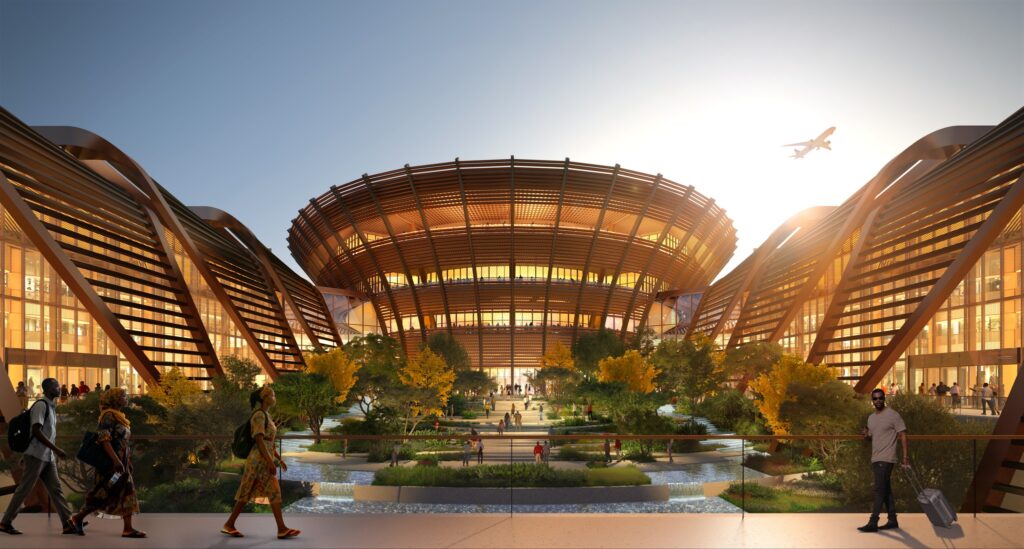
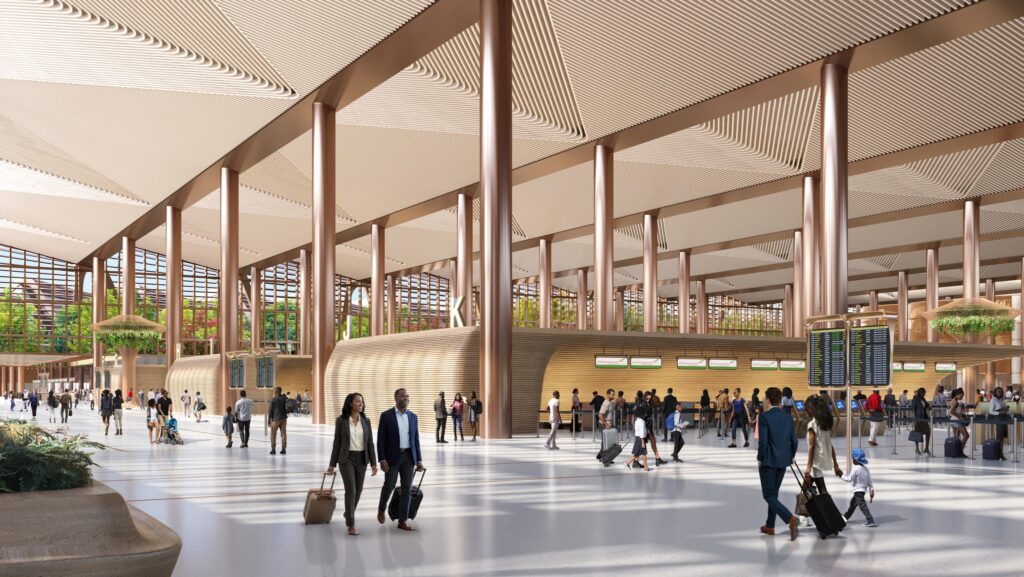
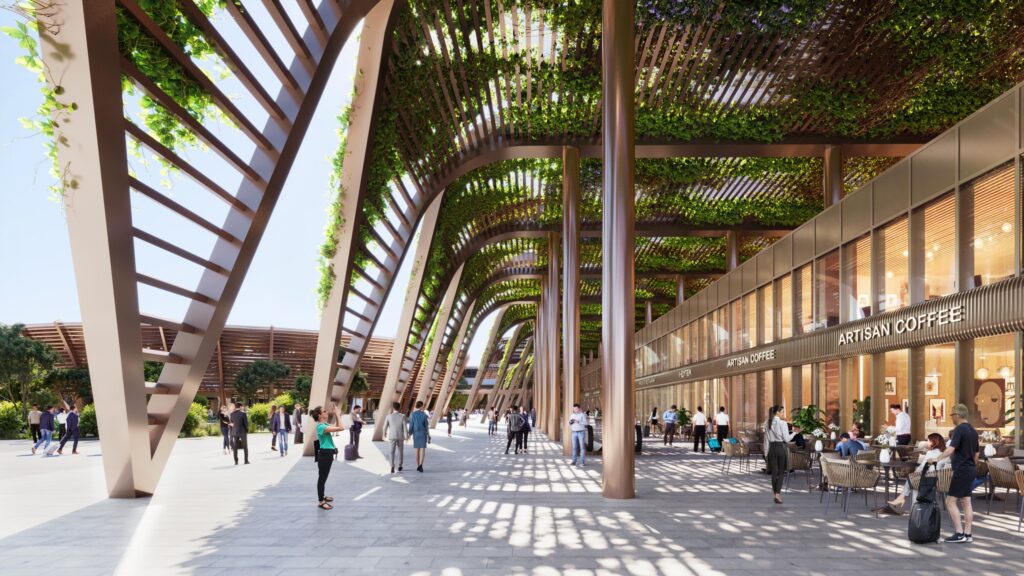
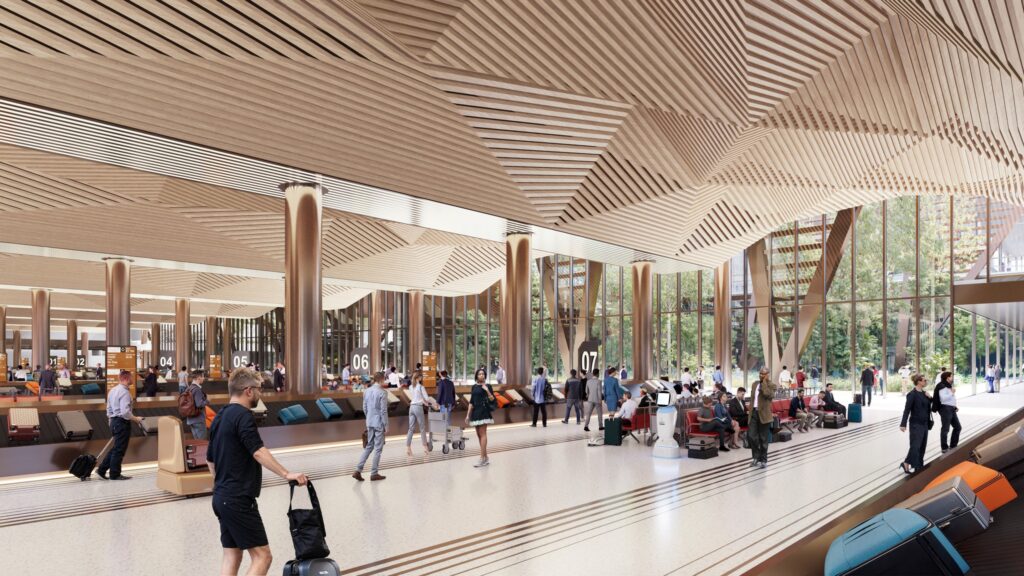
<p class="wp-block-paragraph">Conçu par le cabinet d&rsquo;architecture international ZHA en collaboration avec le maître d&rsquo;œuvre et concepteur aéroportuaire DAR (Dar Al-Handasah), le nouveau terminal est principalement axé sur les correspondances. Ethiopian Airlines estime que jusqu&rsquo;à 80 % de ses futurs passagers seront en transit, se déplaçant entre deux destinations sans quitter l&rsquo;aéroport. En conséquence, le terminal intègre de nombreux services pour les longues escales, notamment un hôtel côté piste de 350 chambres, des espaces de restauration et de loisirs, ainsi que des jardins et des cours extérieures.</p>


<figure class="wp-block-image size-large"><img decoding="async" width="1024" height="549" src="https://archimag.tn/wp-content/uploads/2026/01/aeroport-addis-abeba-4-1024x549.jpg" alt="" class="wp-image-4496" srcset="http://archimag.tn/wp-content/uploads/2026/01/aeroport-addis-abeba-4-1024x549.jpg 1024w, http://archimag.tn/wp-content/uploads/2026/01/aeroport-addis-abeba-4-300x161.jpg 300w, http://archimag.tn/wp-content/uploads/2026/01/aeroport-addis-abeba-4-768x411.jpg 768w, http://archimag.tn/wp-content/uploads/2026/01/aeroport-addis-abeba-4-1536x823.jpg 1536w, http://archimag.tn/wp-content/uploads/2026/01/aeroport-addis-abeba-4-1170x627.jpg 1170w, http://archimag.tn/wp-content/uploads/2026/01/aeroport-addis-abeba-4-1920x1028.jpg 1920w, http://archimag.tn/wp-content/uploads/2026/01/aeroport-addis-abeba-4-585x313.jpg 585w, http://archimag.tn/wp-content/uploads/2026/01/aeroport-addis-abeba-4.jpg 2048w" sizes="(max-width: 1024px) 100vw, 1024px" /></figure>


<p class="wp-block-paragraph">L’emplacement de l’aéroport international de Bole (BIA) joue également un rôle opérationnel stratégique. Situé à près de 400 mètres en altitude de moins que l’aéroport international de Bole d’Addis-Abeba et doté de pistes plus longues, le nouveau site permettra aux avions de décoller avec une charge utile maximale plus élevée tout en consommant moins de carburant. Ethiopian Airlines pourra ainsi exploiter des liaisons directes plus longues tout en transportant davantage de passagers et de fret, un avantage logistique qui influence directement la planification future de son réseau.</p>


<figure class="wp-block-image size-large"><img loading="lazy" decoding="async" width="1024" height="577" src="https://archimag.tn/wp-content/uploads/2026/01/aeroport-addis-abeba-5-1024x577.jpg" alt="" class="wp-image-4497" srcset="http://archimag.tn/wp-content/uploads/2026/01/aeroport-addis-abeba-5-1024x577.jpg 1024w, http://archimag.tn/wp-content/uploads/2026/01/aeroport-addis-abeba-5-300x169.jpg 300w, http://archimag.tn/wp-content/uploads/2026/01/aeroport-addis-abeba-5-768x432.jpg 768w, http://archimag.tn/wp-content/uploads/2026/01/aeroport-addis-abeba-5-1536x865.jpg 1536w, http://archimag.tn/wp-content/uploads/2026/01/aeroport-addis-abeba-5-1170x659.jpg 1170w, http://archimag.tn/wp-content/uploads/2026/01/aeroport-addis-abeba-5-1920x1081.jpg 1920w, http://archimag.tn/wp-content/uploads/2026/01/aeroport-addis-abeba-5-585x329.jpg 585w, http://archimag.tn/wp-content/uploads/2026/01/aeroport-addis-abeba-5.jpg 2048w" sizes="(max-width: 1024px) 100vw, 1024px" /></figure>


<p class="wp-block-paragraph">La performance environnementale est intégrée à la planification du projet, le terminal visant la certification LEED Or. Le bâtiment bénéficiera d&rsquo;une ventilation naturelle, de protections solaires et d&rsquo;espaces semi-ouverts et extérieurs adaptés au climat tempéré des hautes terres de la région. Des systèmes de gestion des eaux pluviales redirigeront les eaux des pistes et des toitures vers des zones humides et des noues de filtration, favorisant ainsi leur réutilisation et contribuant à la biodiversité locale. Des panneaux photovoltaïques produiront de l&rsquo;énergie sur site, et la construction reposera sur des méthodes modulaires utilisant des matériaux locaux ou recyclés.</p>


<figure class="wp-block-image size-large"><img loading="lazy" decoding="async" width="1024" height="576" src="https://archimag.tn/wp-content/uploads/2026/01/aeroport-addis-abeba-6-1024x576.jpg" alt="" class="wp-image-4498" srcset="http://archimag.tn/wp-content/uploads/2026/01/aeroport-addis-abeba-6-1024x576.jpg 1024w, http://archimag.tn/wp-content/uploads/2026/01/aeroport-addis-abeba-6-300x169.jpg 300w, http://archimag.tn/wp-content/uploads/2026/01/aeroport-addis-abeba-6-768x432.jpg 768w, http://archimag.tn/wp-content/uploads/2026/01/aeroport-addis-abeba-6-1536x864.jpg 1536w, http://archimag.tn/wp-content/uploads/2026/01/aeroport-addis-abeba-6-1170x658.jpg 1170w, http://archimag.tn/wp-content/uploads/2026/01/aeroport-addis-abeba-6-1920x1080.jpg 1920w, http://archimag.tn/wp-content/uploads/2026/01/aeroport-addis-abeba-6-585x329.jpg 585w, http://archimag.tn/wp-content/uploads/2026/01/aeroport-addis-abeba-6.jpg 2048w" sizes="(max-width: 1024px) 100vw, 1024px" /></figure>


<p class="wp-block-paragraph"><strong>Construction par étapes d&rsquo;un hub à quatre pistes</strong></p>


<p class="wp-block-paragraph">Au-delà de l&rsquo;aviation, l&rsquo;aéroport est conçu comme le pilier d&rsquo;un vaste projet de développement urbain. Une liaison ferroviaire à grande vitesse reliera l&rsquo;aéroport international de Bandaranaike (BIA) au centre d&rsquo;Addis-Abeba et à l&rsquo;aéroport de Bole existant, tandis qu&rsquo;une cité aéroportuaire adjacente comprendra des bâtiments à usage mixte, des parcs publics et des emplois pour une population locale estimée à 80 000 habitants. Conçu pour fonctionner 24 h/24 sans couvre-feu, ce nouveau hub s&rsquo;inscrit dans la stratégie à long terme Vision 2035 d&rsquo;Ethiopian Airlines, qui vise à étendre les services passagers, de fret et de maintenance de la compagnie aérienne à l&rsquo;échelle mondiale.</p>


<figure class="wp-block-image size-large"><img loading="lazy" decoding="async" width="1024" height="576" src="https://archimag.tn/wp-content/uploads/2026/01/aeroport-addis-abeba-8-1024x576.jpg" alt="" class="wp-image-4499" srcset="http://archimag.tn/wp-content/uploads/2026/01/aeroport-addis-abeba-8-1024x576.jpg 1024w, http://archimag.tn/wp-content/uploads/2026/01/aeroport-addis-abeba-8-300x169.jpg 300w, http://archimag.tn/wp-content/uploads/2026/01/aeroport-addis-abeba-8-768x432.jpg 768w, http://archimag.tn/wp-content/uploads/2026/01/aeroport-addis-abeba-8-1536x864.jpg 1536w, http://archimag.tn/wp-content/uploads/2026/01/aeroport-addis-abeba-8-1170x658.jpg 1170w, http://archimag.tn/wp-content/uploads/2026/01/aeroport-addis-abeba-8-1920x1080.jpg 1920w, http://archimag.tn/wp-content/uploads/2026/01/aeroport-addis-abeba-8-585x329.jpg 585w, http://archimag.tn/wp-content/uploads/2026/01/aeroport-addis-abeba-8.jpg 2048w" sizes="(max-width: 1024px) 100vw, 1024px" /></figure>


<p class="wp-block-paragraph">Cristiano Ceccato de Sabata, directeur du département aviation chez Zaha Hadid Architects, inscrit le projet dans une perspective sociale plus large. « L’aéroport international de Bishoftu est un projet visionnaire pour l’Éthiopie et l’Afrique tout entière. Les aéroports rapprochent les peuples et abolissent les clivages nationaux. ZHA est honorée de participer à son développement, reliant ainsi toutes les régions du continent et faisant de l’Afrique la porte d’entrée mondiale du continent », explique-t-il.</p>


<figure class="wp-block-image size-large"><img loading="lazy" decoding="async" width="1024" height="576" src="https://archimag.tn/wp-content/uploads/2026/01/aeroport-addis-abeba-7-1024x576.jpg" alt="" class="wp-image-4500" srcset="http://archimag.tn/wp-content/uploads/2026/01/aeroport-addis-abeba-7-1024x576.jpg 1024w, http://archimag.tn/wp-content/uploads/2026/01/aeroport-addis-abeba-7-300x169.jpg 300w, http://archimag.tn/wp-content/uploads/2026/01/aeroport-addis-abeba-7-768x432.jpg 768w, http://archimag.tn/wp-content/uploads/2026/01/aeroport-addis-abeba-7-1536x864.jpg 1536w, http://archimag.tn/wp-content/uploads/2026/01/aeroport-addis-abeba-7-1170x658.jpg 1170w, http://archimag.tn/wp-content/uploads/2026/01/aeroport-addis-abeba-7-1920x1080.jpg 1920w, http://archimag.tn/wp-content/uploads/2026/01/aeroport-addis-abeba-7-585x329.jpg 585w, http://archimag.tn/wp-content/uploads/2026/01/aeroport-addis-abeba-7.jpg 2048w" sizes="(max-width: 1024px) 100vw, 1024px" /></figure>


<p class="wp-block-paragraph">La première phase de l&rsquo;aéroport international de Bishoftu devrait ouvrir ses portes en 2030. Elle comprendra deux pistes parallèles indépendantes et un terminal de 660 000 mètres carrés. Les phases ultérieures porteront le complexe à quatre pistes et à une capacité de stationnement de 270 avions, reflétant ainsi l&rsquo;ampleur de la croissance prévue par l&rsquo;IATA pour l&rsquo;Afrique de l&rsquo;Est au cours de la prochaine décennie.</p>


<figure class="wp-block-gallery has-nested-images columns-default is-cropped wp-block-gallery-1 is-layout-flex wp-block-gallery-is-layout-flex">
<figure class="wp-block-image size-large"><img loading="lazy" decoding="async" width="1024" height="576" data-id="4502" src="https://archimag.tn/wp-content/uploads/2026/01/aeroport-addis-abeba-9-1024x576.jpg" alt="" class="wp-image-4502" srcset="http://archimag.tn/wp-content/uploads/2026/01/aeroport-addis-abeba-9-1024x576.jpg 1024w, http://archimag.tn/wp-content/uploads/2026/01/aeroport-addis-abeba-9-300x169.jpg 300w, http://archimag.tn/wp-content/uploads/2026/01/aeroport-addis-abeba-9-768x432.jpg 768w, http://archimag.tn/wp-content/uploads/2026/01/aeroport-addis-abeba-9-1536x864.jpg 1536w, http://archimag.tn/wp-content/uploads/2026/01/aeroport-addis-abeba-9-1170x658.jpg 1170w, http://archimag.tn/wp-content/uploads/2026/01/aeroport-addis-abeba-9-1920x1080.jpg 1920w, http://archimag.tn/wp-content/uploads/2026/01/aeroport-addis-abeba-9-585x329.jpg 585w, http://archimag.tn/wp-content/uploads/2026/01/aeroport-addis-abeba-9.jpg 2048w" sizes="(max-width: 1024px) 100vw, 1024px" /></figure>


<figure class="wp-block-image size-large"><img loading="lazy" decoding="async" width="1024" height="576" data-id="4501" src="https://archimag.tn/wp-content/uploads/2026/01/aeroport-addis-abeba-10-1024x576.jpg" alt="" class="wp-image-4501" srcset="http://archimag.tn/wp-content/uploads/2026/01/aeroport-addis-abeba-10-1024x576.jpg 1024w, http://archimag.tn/wp-content/uploads/2026/01/aeroport-addis-abeba-10-300x169.jpg 300w, http://archimag.tn/wp-content/uploads/2026/01/aeroport-addis-abeba-10-768x432.jpg 768w, http://archimag.tn/wp-content/uploads/2026/01/aeroport-addis-abeba-10-1536x863.jpg 1536w, http://archimag.tn/wp-content/uploads/2026/01/aeroport-addis-abeba-10-1170x658.jpg 1170w, http://archimag.tn/wp-content/uploads/2026/01/aeroport-addis-abeba-10-1920x1079.jpg 1920w, http://archimag.tn/wp-content/uploads/2026/01/aeroport-addis-abeba-10-585x329.jpg 585w, http://archimag.tn/wp-content/uploads/2026/01/aeroport-addis-abeba-10.jpg 2048w" sizes="(max-width: 1024px) 100vw, 1024px" /></figure>
</figure>
<p>L’article <a href="http://archimag.tn/2026/01/17/le-plus-grand-aeroport-dafrique-en-construction-en-ethiopie/">Le plus grand aéroport d&rsquo;Afrique en construction en Ethiopie</a> est apparu en premier sur <a href="http://archimag.tn">ArchiMag</a>.</p>
]]></content:encoded>
					
					<wfw:commentRss>http://archimag.tn/2026/01/17/le-plus-grand-aeroport-dafrique-en-construction-en-ethiopie/feed/</wfw:commentRss>
			<slash:comments>0</slash:comments>
		
		
			</item>
	</channel>
</rss>